DFKI – German Research Center for Artificial Intelligence
Take a closer look at our variety of projects in Oldenburg and Osnabrück!

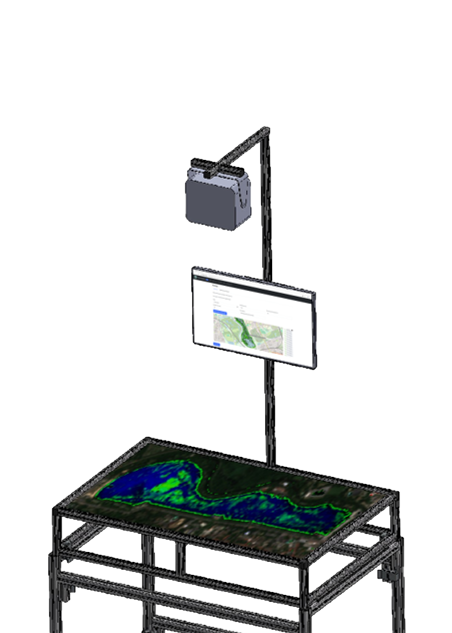
Hybrid AI for transparent and trustworthy decision-making
This project demonstrates how hybrid Artificial Intelligence combines different AI methods to support complex decision-making in a transparent and understandable way.
Using lake management at Hanover’s Maschsee as an example, AI models analyze satellite data, detect aquatic vegetation, and calculate optimized routes for weed-harvesting boats.
The interactive application explains the complete AI workflow, from data analysis to actionable recommendations.
Visitors can explore how AI methods interact, how recommendations are generated, and how they change when input parameters are adjusted.
The project highlights the potential of hybrid and explainable AI for trustworthy decision-making across a wide range of environmental and infrastructure applications.
Curious?
Learn more about…


From perception to
semantic world models
This project demonstrates how autonomous AI systems can not only perceive their surroundings but also develop a semantic understanding of the environment.
As a robot explores its surroundings, it detects objects, identifies their spatial relationships, and incrementally constructs a three-dimensional Semantic Scene Graph.
This semantic world model provides the foundation for knowledge graphs, ontologies, and Large Language Models, enabling complex reasoning and transparent decision-making.
The interactive demonstration illustrates how modern AI combines perception, knowledge, and planning into a consistent world model, supporting intelligent, trustworthy, and human-aligned autonomous systems.
Curious?
Learn more about…
Get in touch

Dr. rer. nat. Martin Günther
Organizational unit: Cooperative and Autonomous Systems (CAS), DFKI Osnabrück
AI-powered clinical decision support for ophthalmology
This project demonstrates how Artificial Intelligence can support ophthalmologists in complex clinical decision-making.
Using chronic eye diseases as an example, AI models analyze OCT images, detect disease-related changes, and combine these findings with information from electronic health records.
The system generates transparent treatment recommendations that support clinical decision-making.
An interactive application illustrates how medical images, patient data, and AI methods work together to provide understandable and trustworthy recommendations.
Developed and evaluated in close collaboration with practicing ophthalmologists, the project demonstrates the potential of explainable AI to enable efficient, patient-centered eye care.
Curious?
Learn more about…